
Recent Posts
About us
Categories
- Kitchen& Food Play
- Doll House Furniture
- Baby Walker
- Balance Bike
- Educational Toys
- Wooden Toys
- Toy Tool Set
- Drawing Toy
- Own Designs
- Montessori Toys
- Vehicle Toys
- Pull & Push Toys
- Rocking Horse
- Toy music instrument
- Dressing Table
- Toy Box & Toy Storage
- Wooden Puzzles
- Wooden Blocks
- Table and Chairs
- Kids Playground
- Kids/Baby Furniture(sets)
- Chess Games & Board Game
- Others
Send a wooden toy inquiry to five suppliers and you will often get the same sentence back. “We use high-quality wood.” That sentence means nothing. Beech, pine, rubberwood, and plywood behave differently. They cost differently. They age differently. They fail differently. At OKEYKIDS, the children’s toy brand of Wenzhou Times Arts & Crafts Co., Ltd., we have spent 24 years making wooden toys for Europe and North America. Here is what buyers should know before they approve a material spec.
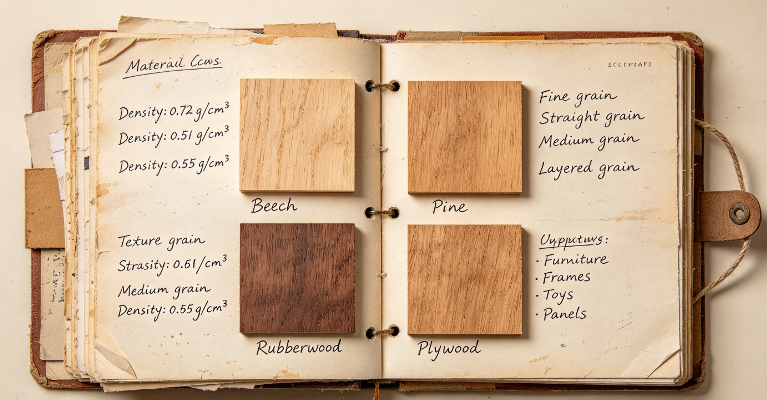
Beech: the workhorse of quality wooden toys.
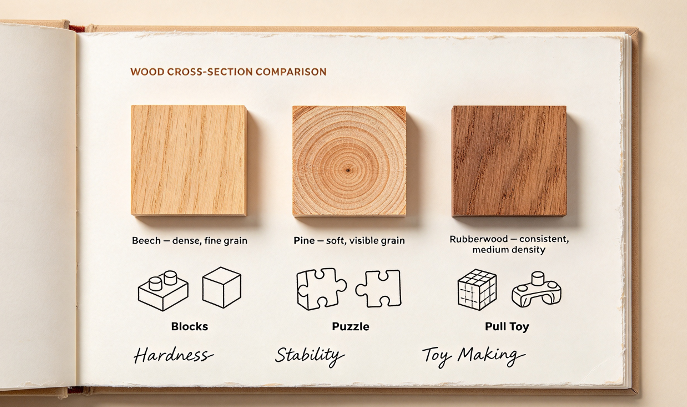
Beech is dense, hard, and fine-grained. It takes paint smoothly. It holds a joint tightly. It resists dents and splinters. This is why beech is common in building blocks, stacking toys, and pull-along toys that need to survive years of use. The trade-off is weight and cost. Beech is heavier and more expensive than pine or rubberwood. For premium brands and heirloom products, the cost is usually justified. For high-volume, low-price lines, it may not be.
Pine: light, affordable, and visible.
Pine is softer and lighter. It has a pronounced grain that shows through natural finishes. This makes it a good choice for toys that are meant to look natural, not painted. It is also more affordable than beech. The trade-off is durability. Pine dents more easily. It can splinter if not sanded carefully. It is better suited to older children and decorative toys than to teething toddlers.
Rubberwood: the practical middle ground.
Rubberwood is a plantation hardwood. It is medium density. It is consistent. It is widely used in furniture and in wooden toys. It takes paint and finish well. It is more affordable than beech and more durable than pine. For many OKEYKIDS products, rubberwood offers the best balance of cost, safety, and longevity. It is not as premium as beech, but it is reliable. For buyers who need volume without sacrificing quality, it is often the right choice.
Plywood: strong, stable, and misunderstood.
Plywood is not a cheap substitute. Good plywood is engineered for stability. It resists warping and cracking. It is strong for its weight. It is often used in puzzle boards, toy boxes, and structural components. The trade-off is that cheap plywood can have voids, rough edges, and formaldehyde concerns. We use plywood only where it makes engineering sense, and we specify the grade. For buyers, the lesson is simple: ask what grade of plywood, not just whether plywood is used.
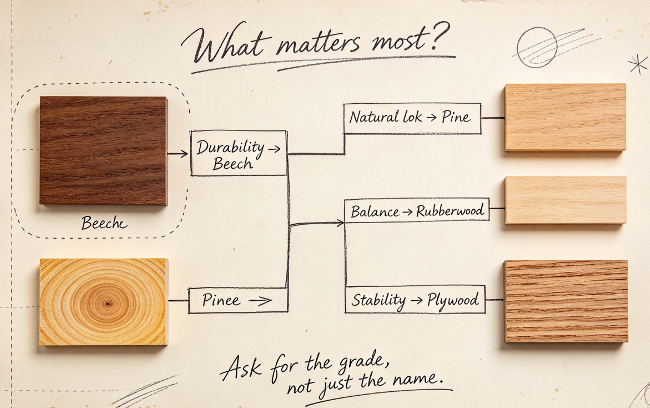
What this means for buyers.
Do not accept “high-quality wood” as a specification. Ask for the species. Ask for the grade. Ask for moisture content. Ask how the material will be finished. Every OKEYKIDS product is tested to EN71 and ASTM F963 standards. We use water-based paints and child-safe finishes. Edges are rounded. Small parts are checked and rechecked. Batch records are kept. If a toy does not pass, it does not ship. Material choice is part of that system. A toy made from the wrong wood for the wrong age group is not a quality product, no matter how well it is finished.
If you are sourcing wooden toys, start with the material. Then choose a partner who can explain it clearly. Explore OKEYKIDS at https://www.okeykids.com/ or request our catalog. We would be glad to show you how we work.


